Thursday, October 8, 2009

Favorites

My apartment contains a very strange mix of furniture. I’ve got a lot of “Swedish” furniture, so much so that one of my friends, seeing a picture of my apartment, asked if we lived in IKEA. I have a few pieces of second-hand Bodzio furniture that I painted for the kids. (If you don’t know what Bodzio furniture is, consider yourself lucky. If you do, then let’s send our props to Bogdan Szewczyk and the furniture manufacturing haven of Twardogóra/Goszcz.) I also have a few (that means 2) antique pieces. Misiu says that they are not really antique. The furniture is more than a hundred years old and I bought it in an antique shop. That’s antique enough for me.

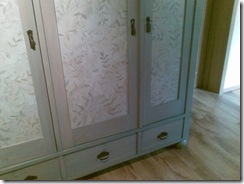
My absolute favorite piece of furniture is our wardrobe. When I spotted it at the antique shop, I couldn’t resist 10072009touching it, stroking it actually. Then the saleslady opened up the wardrobe to show me the inside where she revealed a secret compartment. I was already making up dramatic stories in my mind of previous owners hiding their valuables from the invading Germans, or Russians, or Martians or whomever. I had to have it. I stayed at the antique shop to stand guard over my precious wardrobe as I sent Misiu to the cash machine to get some money for a deposit, pronto!

a top view10072009(002)a close up view 10072009(004)a bottom view 10072009(001)

I cannot tell you where the secret compartment is or what is in it, but wouldn’t you like to know?

Do you have a favorite piece of furniture?

Tuesday, October 6, 2009

Bravo to the city of Görlitz

I’d like to give a Bravo to the German city of Görlitz for standing up to the propaganda of the far right.

The German city of Görlitz is located on the German/Polish border. Across the Neisse River is Görlitz’s twin city, the Polish city of Zgorzelec. Both Poland and Germany are in the European Union, so citizens of both countries are able to travel freely from one country/city to the other or even to reside across the border. In my observation, German people come to the Polish side for services which are cheaper in Poland for example a haircut while Polish folks visit the shops on the German side which are said to have a better selection and better prices than on the Polish side. I’d be lying if I said that this was only difference between these two cities. When traveling from Zgorzelec to Görlitz, I get the distinct impression that I am leaving a poorer city and entering a more affluent one but having said that, things are getting better on the Polish side.

Recently in Germany while the parties were gearing up for elections the NPD, the far right party, hung their controversial party posters not only in Görlitz, but also in other cities of Germany. The posters said, “Stop the Polish invasion!” and showed two black crows stealing Euros. ThPolenis poster not only has an offensive message, it also has old-school style graphics harking back to WW2 Nazi propaganda posters. I don’t think it is by accident. Misiu says that when he looks at these posters he is not disgusted. He thinks it is just the act of some ignorant people. I disagree. Not about it being the work of ignorant people, that I agree with but that it is just the work of some ignorant people. The far right in Germany has more support than you’d suppose especially with younger folks who are having trouble finding their place in today’s society and are looking for someone to blame. Let’s not forget that ignorant people with the support of other ignorant people can do a lot of damage.

On a more practical note, how do Polish people who are entering Görlitz to go to work, to take their children to pre-school, or to go shopping feel when they see the main street lined with these posters? I’d certainly want to take my business elsewhere.

Last week Bernd Lange, the mayor of Görlitz, ordered the NPD to take down the posters as they are in violation of the German constitution which states that all people are equal regardless of their nationality. He stated that these posters are “an affront to human dignity”. When the NPD refused, the mayor had the posters removed and charged the NPD for their removal, citing another case in Germany where such posters were said by the court to be a “public danger”. The NPD disagreed and said that the precedent does not apply in this case and have announced plans to take the issue to court. Görlitz officials have expressed their readiness to fight it out in court if that is what it takes.

Even before the politicians acted to remove the posters, some concerned citizens of Görlitz printed their own posters to hang over those of the NPD. Their posters stated something like “Citizens of Görlitz are open to the world, to foreigners and are against the far right”.

To those who think it is no big deal, just some stupid or harmless posters, we have to think about these posters as the beginning of the NPD’s plan. If you suppose that the NPD has a plan with a final destination, what or where is it? Let’s consider the posters a first step on their journey and extrapolate to 10, 50 or 100 steps down the path. We might see a pretty scary picture and wonder (too late) how we got there.

I have sometimes wondered what I would have done, if I had lived in Poland or in Germany during WW2. Would I have stood up for what was right? I suspect I would have kept my mouth shut at the beginning and then when I finally decided to speak up I would have seen that I was too late, that the fascist mechanism was already in place and I hadn’t done anything to stop it, my lack of protest viewed as tacit approval. Of course, that mechanism doesn’t get set up by itself and it doesn’t happen overnight. It takes support to build it often starting with small acts like a few “harmless” posters. I applaud the city of Görlitz, the government officials and the regular people for fighting against the “first steps” of a return to fascism.

PS I remember my first trip to Görlitz. It was with Misiu and it was purely for the fun of a road trip and also for a little shopping. Misiu had been telling me about the great department store in Görlitz. When we got there, my reaction was, “This is it?” The greatness of the department store in Misiu’s mind had come from the comparison of it with what had been available in Poland during PRL. In light of the many brand-spanking new shopping malls in Poland today, it looked pretty pathetic. That didn’t stop me from buying something, however ;)

PS2 Don’t think that Polish people are not afraid of the German invasion. When I bought my house a rumor spread through the village that a German lady had bought the house- that German lady being me. This part of Poland had been Germany before WW2 and my house was built by Germans and I am foreign so I guess I can understand the confusion. As we were enjoying the yard of our new house for the first time, our new neighbor came to the fence and said, “Hey, fess up. Are you German or what?”

Sunday, October 4, 2009

Something about KIELBASA

You’d think that my blog being called Kielbasa Stories, I’d have more posts (or any posts) about the real thing, Polish Kiełbasa. If you slaskaare reading this and you don’t know what kielbasa is, stick around for a moment and I’ll fill you in. Judging from the keyword search analysis I have done on my blog, a lot of people are asking Google what kielbasa is, what the plural form is, how to export it from Poland to the US, if you can eat it when you are pregnant, how to make fruit kielbasa and the rest of the searches are from dirty, dirty buggers looking for some kind of perverted pornography. Yes, I know who you are.

What is kielbasa?

It is basically sausage and in this case Polish sausage usually made from pork or some pork and beef combination. There are so many different kinds of sausage that I will try to do a brief run-down later in this post.

What is the plural form of kielbasa?

The plural form of kielbasa would be kielbasy following Polish rules. If you are using the word kielbasa as an English word then the plural would be kielbasas. I have seen both kielbasy and kielbasas used in English and have also seen kielbasa used as an uncountable noun.

How do you export kielbasa from Poland to the US?

At this moment, I have no idea. Sorry.

Can you eat kielbasa when you are pregnant?

If it is cooked, I cannot see any reason why not except for possible heartburn concerns.

How do you make fruit kielbasa?

I have never heard of it and am wondering what it could possibly be.

Where is the dirty bugger porn connected to the word kielbasa?

At this moment, I have no idea and I’d like to keep it this way.

Some kielbasa stories…

My very first contact with kielbasa would have to be the supermarket in the US. After Misiu saw what we call kielbasa, he said that it doesn’t count. I guess then we have to say that my first real contact with real Polish kielbasa was in Poland and my first contact or contacts were not good ones.

As I have mentioned before, I could not speak Polish when I came to Poland and the town where I lived did not have any self-service shops. Anyhow, the butcher isn’t a self-service kind of a place, so I had to order what I wanted in Polish. My first trip to the butcher was in tandem with my new best friend from the airport. He managed to come from his town to my town by bus and find out where I lived (I didn’t know where I was going to live previously) by asking the 1st person he met on the street where the American teacher might be living. Of course, as it goes in small towns, that person knew how to find me (and could speak English). I was so happy to see my new friend and we hit the town to buy something to eat for lunch. We went to the butcher close to my apartment (ha, ha, ha, apartment, but that’s another post) and we decided to use my friend’s newly learned word, parówka. The Polish folks who are reading this are now protesting that parówki do not qualify as sausages and I completely agree with you. Parówki are hot dogs and who knows what’s in them. Honestly, we didn’t care at that point. We were so hungry and so happy to have said something in Polish and to have received what we wanted. We returned to my apartment (ha, ha, ha) to boil our hot dogs. We even had bread, mustard and tomatoes. What a feast! We started the water to boil in the one pot I had been given by the teacher who dropped me off at my apartment (ha, ha, ha) and then examined the hot dogs. Each parówek (I know that this is the incorrect form, but it is one of my own creations) was individually wrapped with a kind of plasticey-papery wrap. parowki Consternation…should we take off the wrap before or after boiling? It’s not like in America where every package has instructions out the wazoo including pictures and information how not to injure yourself with said parówka. I don’t remember what we decided but either way it was a risk. The parówki turned out great and we were really pleased with ourselves. We were also pleased that we had not blown up the building. I wasn’t used to using the gas stove yet. In fact, the first time I used it I had to go to my neighbor’s and through foreign language charades ask them how it worked. They were rightly scared to death and showed me at least 10 times and made me show them several times as well. I never did blow up the building but I did manage to catch my sweater sleeve on fire once like from one of those fire safety films from school of what not to do while cooking. If you have never had the opportunity to learn about fire safety from one of those films, then please take my advice and do not wear a sweater with oversized cuffs while lighting the gas stove to boil the kettle for tea. Trust me.

That was one of my first days in Poland. There was a whole year of potential sausage confrontations in front of me. I had to learn to order something other than parówki. The next time I visited the butcher’s, I chickened out and ordered chicken filets (filety). Later as I learned more, I was able to specify that I wanted the filets which were next to the sausages, not the ones that were positioned dangerously close to the hairy (yes, hairy) pig legs in the meat case. On another visit, I toughened up. I knew that I had to order sausages today. There was no way around it, but when I saw the long line of people, I chickened out again and went home to eat cornflakes without milk because I had forgotten to buy it and was too lazy to go back out. Finally, I managed to visit the butcher’s when there was nobody there. I was confronted with the amazing choice of kielbasa in front of me. I didn’t know any names of any sausages and I didn’t know any adjectives either to describe what kind of sausage I wanted. I just found the first one that I could pronounce and ordered (who knows why?) a kilo of it!! The kielbasa I had ordered was named after the street of the local slaughterhouse where it was made. It wasn’t very good.

I swore off sausage for awhile, a long while actually because I didn’t return to it until Easter time when my students told me that I had to try biała kiełbasa, white sausage, which is part of the Easter tradition. I had avoided this sausage until then because it looked kind of gross. It’s fat and white and looks like abiała big fat finger cut off of a big fat hand. Even after it is cooked, it still has an unhealthy gray color. White sausage is pretty good but it is raw and you obviously have to cook it first. Not knowing anything about sausages, I sometimes didn’t know what to do with some sausages that I had bought. Were they cooked or smoked already? Should I boil them, bake them, fry them or eat them as is? It was a lot to think about for one American girl.

At Easter time, I was invited to Misiu’s parents for tea. Misiu and I had met at work and I think he felt sorry for me that I had no Easter plans. His mother, my now mother-in-law, is a huge sausage fan but this was tea time so she served tea, coffee and cake. With my Misiu, there is an eating habit between us which I noticed at that tea and it still continues today. When we eat dinner, I eat very slowly and Misiu eats pretty quickly. When we eat something sweet, Misiu takes baby bites and I inhale what I’ve got and start to eye up his portion. It was true on that day as Misiu slowly stirred his coffee and I started in on the cheesecake (sernik, my m-i-l makes the best ever) and apple pie (szarlotka). I took a big bite of one and thought that it tasted a bit funny but who cared, it was cake. I tried the next one and it too had a funny taste, but I was hungry and a guest should never complain. Misiu was practically still stirring his coffee while I had finished two pieces of cake. He finally tucked into his piece. One bite and he screamed, “Mamo!!! You put the cake in the fridge next to the sausages again!” That was the funny taste. It was sausage cheesecake and sausage apple pie.

White sausage even made an appearance years later at my wedding reception. Our wedding reception was held in a traditional restaurant and we chose the “Wild Game” menu. There was a lot of wild pig, hare and sausages. There was even something call bread soup which was a kind of white sour soup (like żurek) with pieces of white sausage and bread in it. There was kaszanka even some kaszanka (black pudding or as some people call them blood sausages) but I said no thanks as I always do to kaszanka, flaki (tripe) and golonka (pork knuckle). To be fair, I have tried them all so I am sure that I don’t like them. At a cousin’s wedding reception, my mother-in-law even separated the meat from the fat of the golonka for me and I still didn’t eat it. It caused a scandal among the guests that I am such an American princess that I won’t even eat the meat cut up for me by my mother-in-law. Add that to the fact that I don’t/won’t/can’t dance and do not drink vodka and I am the most hated Polish wedding reception guest ever.

Although kielbasa is one of the first foods that comes to mind when you think about Polish cuisine, it is not easy to find in a restaurant. In our Polish family, we eat white sausage on Easter. We eat sausage with bread sometimes for breakfast okabanosyr as a snack. I sometimes buy Lizzie a kabanos when we are at the butcher the way some people would buy their kid a lollipop. We use kielbasa in leczo and in bigos (hunter’s stew) and very rarely we cook or grill a large sausage and eat it with mustard and bread. We never order it in a restaurant. We buy our sausage from a butcher that we know and once we even had a pig butchered and split it with my sister-in-law and parents-in-law. When we bought our house, it had a smoke room upstairs and one of my students is so fed up with the quality of meat in the shops that he eats only meat from his own animals and is building a smokehouse next to his garage. If you are desperate to eat some sausage not prepared in your own kitchen, you should look for it in two kinds of restaurants. One would be the road-side restaurant or bar. Another would be a restaurant featuring traditional cuisine- staropolska kuchnia. I tend to judge the quality of the sausage by the price. I know that my system is not perfect and expensive sausage can be awful too but in my experience expensive sausage can be awful or it can be good. Cheap sausage is always awful. If possible when buying check the ingredients list carefully. Some sausages can contain as little as 20% meat. Once I bought my mother-in-law a pretty pricey piece of sausage because I know that she likes good sausage. When she saw the price she exclaimed, “Who is that kind of sausage for!?! For people!?!” My answer which was not verbal, just a kind of look on my face could best be written as !?! If not for people, than who for?

If you are in the category of people and you’d like to try some Polish kiełbasa, here’s a list of just some kinds. In my unscientific research, I have found that sausages with the same name can be made different ways. The same sausage can be smoked or dried or even double-smoked. I thank our local butcher who gave me a lot of information which confused the heck out of me and with the final moral of the story being that every butcher has their own recipes. I have to stop now with the sausages because I have a headache.

Swojska/Domowa/Własnej roboty = homemade

Śląska = Silesian made from pickled meat??? with salt, pepper, garlic, marjoram

Wiejska = country style - smoked, pork, bacon, salt, pepper, garlic, sugar, marjoram

Torunska = Toruń style

Krakowska = Kraków style – smoked, beef/pork, salt, pepper, coriander, nutmeg, cayenne pepper, sweet pepper, a fatter sausage

Jałowcowa = Juniper sausage

Podwawelska = Wawel style - similar to Krakowska but a thinner sausagepodwawelska

Zwyczajna = regular sausage –pork/beef, salt, pepper, sugar, juniper, garlic, allspice

Biała = white sausage – raw, pork, salt, pepper, garlic, rosemary, marjoram, parsley

Myśliwska = hunter’s sausage - dried, pork/beef, salt, pepper, garlic, cumin, coriander

Żywiecka = Żywiec style

Szynkowa = “Ham” sausage - thick and good for slicing like a ham

Góralska = mountain style

Grillowa = for the BBQ - usually fattier than other sausages

Kabanos = something like a jerky sausage - thin and dry

Pasztetowa = Liverwurst – often for spreading

Salceson = Headcheese

Mortadela = Bologna

Parówki = hot dogs

Adjectives

tłusta = fatty

chuda = lean

twarda = hard, firm

surowa = raw

gotowana = cooked

sucha = dry

podsuszana = dried

wędzona = smoked

PS I got freaked out once at the meat case when I noticed veal sausages called cielęce and then I noticed another sausage called dziecięce and for a split second I thought the worst. Cielęce=veal sausages meaning made of veal and dziecięce = children’s sausages, made for children not made of children.

PS2 In another visit to the meat case I found not dziecięce but dziecinne, childish sausages :)

PS3 When in NYC, we visit either Mazur Meat Market or Kiszka both located in the Polish district Greenpoint in Brooklyn. The line out the door speaks for itself.

PS4 If you know Polish check out this link http://nonsensopedia.wikia.com/wiki/Kiełbasa

Smacznego!

Friday, October 2, 2009

Say “chee-eese”!

I hate being photographed. It’s something I got from my Grandmother. She always hid her face with her hand or a well-placed coffee cup or turned away from the camera. She did it every time the camera came out until one holiday when I think she realized it may be our last chance to get a picture of her or with her. I have one great photo of the two of us together, both of us smiling and looking at the camera. When I look at the picture, I remember her smile, her wry sense of humor, her frail body, her fragrance. I’m so grateful to her for that one picture. I loved her so much. As it turned out her feelings were right and that was our last chance. Maybe that’s also why I have pictures of her hanging in my home here in Poland. The pictures are from an earlier age when my Grandma allowed herself to be photographed. Maybe she even liked to be photographed. I can see my Grandma as she was before she had children, her wedding, as a newlywed, as a new mother, marrying off her first born son.
IMG_0001_NEWPS
my Grandmother
IMG_0002_NEWPS2
my Grandfather
(I never met my Grandfather as he died before I was born. . From this picture, I like to imagine him as a romantic gangster. I think it is because of the car.)

I don’t have any pictures of my parents, recent or otherwise. I have asked them on several occasions to send me some so I can show my children who they are and who we are talking to on the phone. I send tons of photos to my parents and to my sister but nobody sends any to me because I am the one who is far away in another country, not them. They don’t realize that they are just as far away for me.
I am the younger sibling, the younger sister. I am the Rosie in the family. My sister has hundreds of photos of her childhood. I have one album. I’d really like to be able to see more of myself as a child now that I am a mother. What I want to see even more than pictures of myself as a child are pictures of my parents as young parents, in the stage of life I am now. I realize looking at my kids pictures that I should turn the camera around sometimes (because, yes, you can go to the seaside or to the zoo or to another country and come back with 500 pictures of your kids smiling faces and nothing else) to show my girls (and myself) what I look like as a young mother.

IMG_NEW
PS Misiu’s surprised reaction to seeing my and my sister’s baby albums had nothing to do with the amount of photos but the quality. He exclaimed, “Your baby photos are in color!” because his are not.

PS2 I feel that I am a “young mother” despite the fact that the Polish hospital designated me as a mom of advanced maternal age at my first birth at age 32! How dare they?!

PS3 An example of my Grandma’s sense of humor: Once when Misiu first came to the US to meet my family, he wasn’t sure what to make of my family and they were not sure what to make of him. After a trip to the grocery store, Misiu was happy to help us carry the bags in and put the shopping away. Misiu put the milk and cheese in the fridge and the bread in the bread drawer. He didn’t know where to put the cereal boxes so he asked my Grandma what to do with them. She answered, “Bend over,” and escaped to her bedroom laughing her characteristic laugh.

UPDATE 2015 - My parents finally broke down and had professional photos taken, and my children finally got a chance to visit their grandparents. Photos from that session were used recently at my father's funeral.

Wednesday, September 30, 2009

A Misiu by any other name…

…would be just as cuddly, wouldn't he? This is not going to be a post about my Misiu, but rather about the word misiu and other terms of endearment. If you are Polish, you already know that my husband’s given name can’t possibly be Misiu. If you are American, you might be surprised to find out that in Poland you cannot just name your child 09292009whatever you want. The name you choose has to be an actual name, not something you just made up, not a city, state or country, and definitely not anything embarrassing, offensive or vulgar. That’s why you’ll find 5 Agnieszka’s in one class and not any Misiu’s. Why? Because Misiu is not a name. It means teddy bear. It comes from the word bear- miś -and can also appear as misiaczek , the diminutive of miś, which means little bear.

Perhaps it is good that you cannot name your child whatever you want in Poland. This regulation means that no kids have to defend themselves from attacks of other kids about their stupid name. However, stupid is subjective and what is one person’s idea of a beautiful name can be another person’s idea of sheer stupidity. If you are Polish and your name is Esmeralda, then you know what I am talking about. (Leticia Calderon as Esmeralda, pictured below) I think givLeticia Calderon Esmeraldaing your Polish child an English name (or foreign name) is ok but then please go all the way and spell it in English not in Polish, for example- Brajan Nowak, Majkel Kowalski. I understand that the parents have chosen that spelling in order to ensure that it will be pronounced as they want. Brajan is the Polish phonetic spelling of Brian.

I have found that many Polish people make assumptions about children with foreign names (especially foreign names spelled po polsku) and those assumptions are usually negative. That’s one reason my kids have traditional Polish names. Lizzie and Rosie are just their nicknames. We thought long and hard about naming our children. We had a short list for both boys and girls and we tested them out on my parents and on my parents-in-law. We decided to choose traditional Polish names because now we live in Poland and also because in the US it is more acceptable to have an unusual name. We threw out names such as Katarzyna-too difficult to spell in the US, Agnieszka-extremely popular in Poland, a nice name in Polish but the English equivalent Agnes isn’t as nice in our opinion, Magda is quite universal, the same spelling in both languages but the English pronunciation is not as nice as the Polish pronunciation. We also decided against the name Daria, supposing that our daughter could have the unfortunate nickname of diarrhea her whole life. Obvious choices for boys were Adam or Robert which are the same in Polish and in English. We also liked Aleksander and Maksym. We thought a son could have a nice nickname of Alex or Max. We decided that names like Zdzisław or Zbigniew were definitely out as they are practically unpronounceable for typical English-speaking people. In the end, we didn’t have to choose from the boys short list.

I remember the first day of one of my university classes. Our professor asked us to go around the room, introduce ourselves and tell something interesting about ourselves. I was 18 years old and there wasn’t anything really interesting about me at that time and I don’t remember what I said. What I do remember is that one of my classmates introduction went like this: Hi. My name is Sunshine and yes, my parents are hippies. Sunshine is a really unusual name. I’ve met a Sunny or two over the years but only one Sunshine. However unusual the nam09292009(009)e was, the girl was quite ordinary and after a week or two I totally forgot that her name was unusual and called her Sunshine without a smile on my face. I heard that in Poland there is a man named Solidariusz (a combination of the name Dariusz and the word Solidarity) in honor of the Solidarity movement. I wonder how he feels about his unusual name. I’d similarly like to ask all those Anna’s and Agnieszka’s of Poland how they feel being the next Anna or the next Agnieszka in the group.

In America, my life as a teacher was a hard one. My students had names which originated only in the minds of their parents or on the pages of hot new baby name books. There were no Mary’s, no Robert’s, no John’s only Alexia, Alicia, Alisha, Aleesha, Lexi, LaToya, LaToyer, and so on. I really am all for freedom to name your child what you want and while these names were troublesome for me the teacher, they we actually no big deal. It’s not like the family I read about who named their poor little child Adolph Hilter and caused a big stink when the local bakery would not write Happy Birthday Hitler on the kid’s birthday cake. (Yes, ‘cause we are free like that in the great US of A.) And one more thing, why do all of those F-ed up people have to come from Pennsylvania?

Do I know how to digress or what? I wanted to write about terms of endearment and I ended up on a kid named Hitler. (not any relation to a boy named Sue – that’s for the Jonny Cash fans) What are some Polish terms of endearment? My personal favorite is misiu. I find that is more often used by women for their men and also for kids. If you want to get the attention of a lot of men, I recommend saying Miiisiiuuu (meeeeshoooo) in a crowded IKEA on a Saturday afternoon. I guarantee every guy within earshot will turn their attention to you. I had a male acquaintance from New Zealand who took great offense when one of his students called him misiu. He exclaimed, “What? I’m not fat!” There is the suggestion that when using the term misiu, the recipient should be a little misiowaty, I mean kind of soft and squishy and huggable like a teddy bear. My Misiu fits the bill but I would qualify him as a pół-misiu, a half teddy. He’s not as squishy as he could be.

I also like that you can easily make the diminutive even of people’s given names. The diminutive is sometimes longer than the original but sounds sweet and little. Anna changes to Ania or Anka. Katarzyna changes to Kaśka. Zbigniew changes to Zbyszek. Marek changes to Mareczek. Hitler changes to Hitlerek which is Rosie’s current nickname. She’s a real tyrant. Lizzie’s current nickname is monsterek, our version of potworek or little monster.

Here are some more popular terms of endearment:

kochanie –love, sweetheart

żabka – froggy

słoneczko – sunshine

kotek, kicia, kiciuś – kitten

myszka – little mouse

kwiatuszek – little flower

ślicznotka – my pretty

żoneczka – wifey

mężulek – little husband, hubby - This one will also get all the guys at IKEA to give you a look. They will give a sad look at your whipped husband as well.

So I have shared with you my nickname for my husband which is misiu. Are you wondering what his nickname for me is? He can’t make up his mind but his top 3 names for me are:

mordka/mordziak - little mug, not coffee mug but mug-shot mug

gruba - fatty, which I am not

stara - the old lady, which I definitely am not

Romantic, isn’t he?

What are your favorite terms of endearment?

Monday, September 28, 2009

How I learned I was fat

I was one of those kids blissfully unaware that someone could be considered fat or thin or that being either fat or thin had any meaning in life other than having to buy bigger or smaller clothes.

Until the day I was made aware.

Ok, let's face it, I was a big kid compared to the rest of my class at the Immaculate Conception Catholic School (yep, that’s the real name, try to explain to a bunch of 5-year-olds what it means). Not only was I the biggest kid in my class, I was also bigger than our classroom teacher and bigger than our principal Sister Sandra. Do you remember how tall you were and how much you weighed in elementary school? I do, thanks to the once-a-year height/weight check performed by our always tactful PE teacher Mrs T. In the 5th grade, I was 5 ft. 4 in. tall and weighed a slightly pudgy 116 lbs (162 cms, 53 kgs). In the 6th grade, I was 5 ft. 6 in. tall and weighed 110 lbs (167 cms, 50 kgs) and I haven't grown an inch taller since then. Hardly a fatty you say, but those times were different. Anyone over a hundred pounds was deemed suspicious. I remember exactly because it was commented by Mrs T. that I was on the road to obesity (she didn’t use the actual word obese, she used just plain old fat) as she could practically predict my miserable future based on those miserable height/weight figures and also on my inability to overhand serve in volleyball (or underhand serve for that matter). I brushed it off not really knowing what she was talking about, but I started to think.

I figured it was pretty much bull. I was an active kid. I played AYSO soccer, but later in gym class while wearing my beloved AYSO shirt, Mrs. T., always sympathetic to the fragile self-esteem of children, asked me who I got my shirt from. When I replied that it was mine she said in disbelief, “they’ll take anybody these days.” OK, I said that I played, not that I was any good. I started to think.


Then one day I forgot my lunch at home. In the 1st grade, this was reason enough for total nuclear meltdown but in the 6th grade, I thought I'd just have to suck it up and wait until I got home. Unavoidable question from the lunch monitor, “Where's your lunch?” My honest answer, “I forgot it at home.” That couldn't possibly be the truth and an impromptu conference between the lunch monitor, our teacher and the principal ensued. A decision was made--to call my mother and explain that in a desire to lose weight I had been skipping lunch. Funny that not even one of them thought to offer me any lunch, but anyhow. My mother, thank goodness, had enough sense in her head to see my forgotten lunch in the fridge at home and to only tell me not to forget it and to carry some extra money with me to school in case that happened again.

That was the 6th grade, my last year in elementary school. I think kids nowadays would be really lucky to be unaware of things such as weight, sex, drugs till that age. Let’s fast forward to the summer after 7th grade at the church fair where I ran into our elementary school principal, “Hi, Chris. It's good to see you. Don't lose any more weight.”

PS. How did they explain the meaning of Immaculate Conception to the young pupils of the school? They ran a kind of Bill Clinton/gays in the military “don’t ask, don’t tell” policy. If we didn’t ask, they didn’t tell us. Usually our school was referred to as the Catholic school (there’s only one in the area) or simply IC. The kids from our class did finally ask in about the 3rd grade (apparently we were not very sophisticated or curious for that matter and we didn’t even have Google back then). Our teacher gave us a kind of general explanation of God giving the Virgin Mary the baby Jesus in a special and holy way and even explained to us that “virgin” meant “holy”. We agreed and immediately began using the word virgin as a synonym for holy as in the Virgin Jesus or the Virgin God. Our teacher never did explain to us exactly what it meant but she did tell us to stop using it when we referred to our principal as the Virgin Sister Sandra.

Thursday, September 24, 2009

Maiden name or husband’s name?

Have you heard the old joke?

What is long and hard and you get it from your Polish husband on your wedding night? His surname!

Ha, ha, ha.

You cannot imagine how many times I have heard this stupid joke. I don’t even pretend to laugh anymore. My husband’s surname is not that long and not really that hard either, but I still decided to stick with my own name. Why? It is because I'm a strong, independent woman who doesn't want to be enslaved by the patriarchy of society by being forced to take my husband's name.


If you believe that then you don't really know me. I'm just simply lazy. I got married in Poland so by law I would have to take the feminine form of my husband's name and then go to court to request a name change to the masculine form. I wanted to have the masculine form that my husband has so that in our American ID's, we would have the same name. Then I would have to change all my Polish ID’s and all my American ID's. Get the picture? And did I mention that I'm lazy.

PS. Once while at the hospital after my 1st child was born, the nurses were calling for me by Mrs and my husband’s surname (because our children carry their father’s name). For a split second (ok, it was longer than that - I was kind of spacey after the birth), I looked around to check if my mother-in-law was there and wondered what they were calling her for.

Ladies, opinions???